James Hardie Installation in Omaha: A Quality Checklist Homeowners Can Use
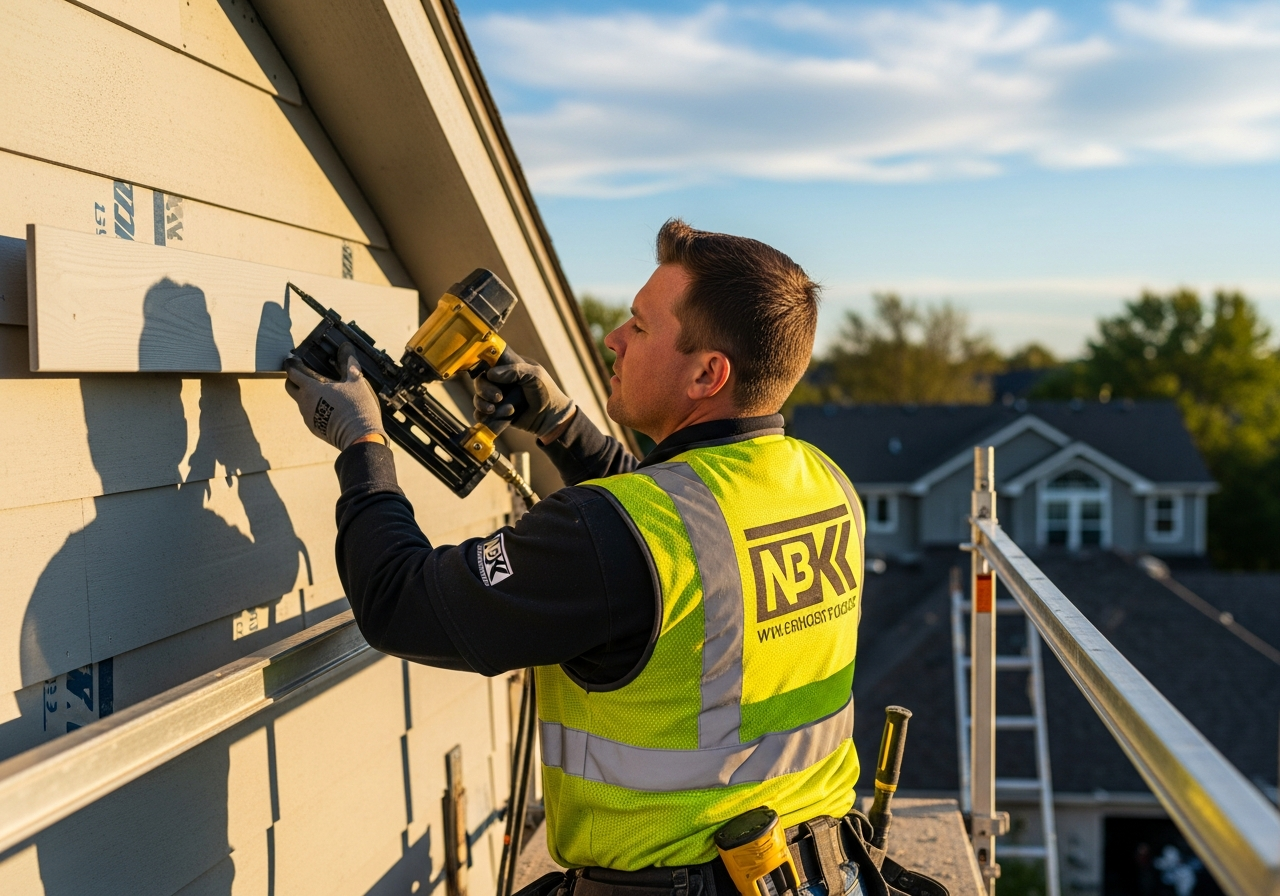
Hardie's substrate warranty is 30 years. The catch: the warranty is contingent on installation per Hardie's published instructions. We've walked into Omaha Hardie jobs that voided the warranty on day one — and the homeowner had no idea. Here's a checklist any homeowner can use to verify a quality fiber cement install on their own house.
Before tear-off begins: agree on the substrate plan
A real Hardie install starts with full tear-off down to the sheathing. "Re-siding over existing siding" is not a Hardie-approved install — and even where Hardie permits it conditionally, doing so means you can't inspect the substrate, can't replace the wrap, and can't renew the window flashing. Refuse over-cladding.
Verify at tear-off
- OSB or plywood sheathing condition — replace any rotted sections with proper-thickness lumber.
- Window and door flashing — almost always undersized or missing on pre-1995 Omaha homes.
- Existing house wrap — almost always failed or improperly lapped on older homes.
House wrap done once, done right
New 6 mil house wrap with proper laps (top course over bottom course, like shingles), shingled into window flashing, and taped at all seams with appropriate tape. Mechanically fastened with cap nails or staples per the wrap manufacturer's spec.
Cheap Omaha Hardie bids often skip wrap renewal entirely or do it with budget product and zero tape. That single shortcut is where most underperforming Hardie jobs trace their leaks back to.
Window flashing — the real install quality test
Walk past any active Hardie install in Omaha. If you can see proper window flashing — full sill flashing pan, butyl tape on the jambs, head flashing tucked under the wrap — that's a quality install. If the windows are just being caulked in place, that crew is cutting corners. Hardie publishes specific best-practice flashing assemblies. They should be followed on every install.
Kick-out flashing where roofs meet walls
Where a roof terminates against a sidewall, kick-out flashing is required. Without it, water rolls off the roof and dumps directly behind the siding into the wall cavity. Most pre-2000 Omaha homes do not have kick-out flashing. Most cheap Hardie bids don't add it. We always do.
Clearances are not optional
Hardie publishes minimum clearances:
- From grade: 6 inches
- From decks, paths, and driveways: 2 inches
- From roofing: 1–2 inches depending on roof type
Skipping these clearances voids the warranty. We see violations on roughly half the Hardie jobs we audit from other contractors — usually planks installed all the way down to the deck or grade. If a finished Omaha Hardie job doesn't show clear gaps in all the right places, it isn't a Hardie-approved install.
Fasteners — spacing, depth, the right tool
Hardie planks need to be face-nailed or blind-nailed at specified spacing — typically 16" on center for blind-nail and 24" for face-nail. Fastener heads must be flush, not over-driven. Over-driven nails crack the plank under the head and are the most common Hardie warranty issue.
A proper crew uses pneumatic nailers calibrated for fiber cement, not standard framing nailers cranked up. Worth asking about.
Butt-joint detail — caulk is not a Hardie-approved joint
Hardie plank butt-joints should be staggered (offset by at least 24") or aligned on a stud with proper joint flashing behind them. Caulked butt-joints are not a Hardie-approved detail — they look fine for a season and crack open the second winter. Z-flashing or factory butt-joint flashing is the right answer.
Sealant and paint touch-up
Final detail is exterior-grade urethane or Hardie-approved sealant on trim joints (not on panel butt-joints), plus color-matched paint touch-up on cut edges of pre-finished ColorPlus® planks.
Warranty registration is your job to verify
The Hardie 30-year substrate warranty must be registered. Most Omaha homeowners don't know this and never check. Ask your installer for the registration confirmation in the project closeout package.
Six questions to ask any Omaha Hardie installer
- Are you a Hardie Preferred Contractor or higher tier? (Ask to see the certificate.)
- Will my install include full house wrap renewal?
- How will you handle window and door flashing?
- Will you install kick-out flashing where missing?
- How will butt-joints be detailed?
- Will you register my Hardie warranty in my name?
If the installer can't answer all six clearly, get a second bid. The cost difference between a cheap Hardie install and a quality one is usually 10–15% — and it's the difference between a 30-year warranty and a wall that fails in 8 years.
Get a quality bid
Free written estimate, every detail line-itemed, every Hardie spec call-out included. Talk to a certified Omaha Hardie installer.